

Frequently Asked Questions
All Health Professions programs are offered as Credit or Continuing Education (CE).
- Credit courses are generally taken as part of a degree program and provide college credits. These course grades are listed on your college transcript and will affect your Grade Point Average (GPA).
- Noncredit courses (Continuing Education) are offered to provide a purposeful and systematic process of acquiring and recording lifetime learning for individuals. These courses are not listed on your college transcript with traditional letter grades, nor, will they affect your GPA.
Health Professions - Associate of Applied Science (AAS) Degree: Consists of 60 credit hours. AAS degree is listed on your college transcript, and with completion, you are eligible to participate in graduation.
Health Professions Level 1 Certification: Consists of 18-30 credit hours, depending on your program of choice. Level 1 Certification is listed on your college transcript, and with completion, you are eligible to participate in graduation.
ICLC - Institutional Credentials Leading to Licensure or Certification: Consists only of the courses required to complete your desired certification through the credentialing body. Please review the program flyers or the current student catalog for the required ICLC courses for each program.
Visit the Health Professions Program page to view options.
Please email us at healthprofessions@collin.edu for this information.
Required for Certified Nurse Aide (CNA), Phlebotomy Technician, and Patient Care Technician clinical program students only.
These requirements do not apply to EKG Technician program students as of Fall 2025.
Please note: Students in the health care (non-veterinary) fields must have certain vaccines due to their coursework, which may expose them to viruses and bacteria at a higher risk. Per Texas Education Code 51.933, Health and Human Services may write rules requiring students enrolled in health-related courses to receive certain vaccines. This information can be found in Title 25, Texas Administrative Code §97.64.
- Diphtheria/Tetanus/Pertussis (Tdap) = One dose within the last 10 years
- Hepatitis B Series = Completed traditional 3-dose series OR Two-dose accelerated HEPLISAV-B series (this option is only available to age 18+) OR positive blood titer results
- Measles(Rubeola)/Mumps/Rubella (MMR) = Completed two-dose series OR positive blood titer results
- Varicella (Chicken Pox) = Completed two-dose series OR positive blood titer results (history of disease is not applicable)
- Current Flu Shot (available from September - May of each year), not required for the summer semester.
- Proof of Negative Tuberculosis (TB) Screening Test or Negative Chest X-ray (PPD Skin Test, QuantiFERON-Gold, or T-Spot Blood Test accepted), must be dated within the last 12 months and valid through the end of your clinical course.
- Bacterial Meningitis (exempt if student is at least 22 years old) = one dose required (Only required for students who attend courses on a Collin College campus, this is completed upon admission to the college)
**Please review the following section regarding other clinical requirements for our programs.
The Health Professions Program complies with the Americans with Disabilities Act (ADA) and is consistent with the ADA. The Functional Abilities/Core Performance Standards provides a framework for relating functional ability categories and representative activities/attributes to any limitations/deficits in functional abilities. These standards shall be used by the Health Professions Program in combination with the professional scope of practice, job analysis, other resources, and expert consultation to make decisions related to the ability of the student to perform the essential functions.
If a prospective student is unable to meet one or more of the standard(s), even with correction (e.g. eyeglasses, hearing aids) on any of the items listed in the required “Functional Abilities/Core Performance Standards,” the Health Professions Program in consultation with an advisor from the Accommodations at Collin College for Equal Support Services (ACCESS) Office will determine, on an individual basis, whether or not reasonable accommodations can be made that would permit the student to meet these “Functional Abilities/Core Performance Standards” and thus, to continue in the program.
Please note: “Skill(s) tied to” under each of the sections is not intended to be a complete listing of skills, but rather as an example of a skill for which that ability is required.
Functional Abilities
Manual Dexterity
- Write clear and legible progress notes when needed.
- Write clear communications within multidisciplinary teams.
- Manipulate small objects (e.g. phlebotomy supplies).
- Type, maneuver a computer mouse, and adjust the computer controls of a charting system and/or telemetry system.
Mobility
- Remain at a patient’s side for a prolonged period of time without sitting for purposes
of monitoring and observation
Perform CPR. - Manually position clients that are lying in a bed or sitting in a chair.
- Lift fifty (50) pounds of weight without assistance.
- Push an occupied wheelchair, shower chair, or stretcher.
- Move immobile patients from stretcher to bed, bed to stretcher, or bed to chair and back, alone, with assistive devices and/or with assistance from other personnel.
Processing Client Information
- Respond to communication by patients professionally.
- Respond to monitor alarms, emergency signals, and call bells from patients in a noisy environment.
- Identify changes in patients and report them.
- Identify odors such as smoke and spoiled food.
- Rapidly and accurately identify cyanosis, absence of respirations, and movement of patients visually monitor patients in dimmed light.
- Protect confidential information in accordance with the Health Information Portability and Accountability Act (HIPAA) and the Health Information Technology for Economic and Clinical Health Act (HITECH).
- Respond quickly to emergency situations and assist with equipment, diagnostics, and/or performing CPR.
Math Competency
- Tell time (standard and military) reading both digital and analogue watches (ability to follow second hand).
- Perform basic math and algebra skills (e.g. addition, subtraction, multiplication, division of whole numbers, decimals, and fractions).
- Use measuring tools.
- Record numbers.
- Measure accurate intake and output fluids.
- Calculate heart rate.
Emotional Stability
- Provide emotional support to patients.
- Adapt rapidly to environmental changes and multiple task demands.
- Maintain adequate concentration and attention in patient care settings.
Critical Thinking
- Identify cause and effect relationships.
- Sequence information in a manner that is logical and understood by others.
- Make sound clinical judgments and decision based on standards of patient care.
- Seek assistance when clinical situations require a higher level of expertise or experience.
Communication
- Speak, comprehend, read and write English as needed for accurate and clear communication.
- Respect differences in clients and patients.
- Establish and maintain effective working relationships with clients and co-workers.
- Provide information in an accurate and effective manner.
- Report any changes in patient condition.
- Convey information to others through graphic print, and/or electronic media in an accurate, timely, and comprehensive manner.
Professional Behavior
- Notify the instructor of any absences.
- Be punctual for scheduled classes, labs, and clinical shifts.
- Seek learning opportunities whenever possible while in the clinical setting.
- Accept responsibility for your own actions, maintain integrity, and accept feedback from instructors as a learning opportunity to help make appropriate changes in behavior and skills.
- Identify your own strengths and areas for growth in your assigned settings.
- Follow the program’s dress code.
- Complete assignments and assessments as required.
Important Considerations
As you consider applying for a Health Science program, it's important to be aware that the curriculum for certain clinical programs may include exposure to mature content. This content is essential for understanding the complexities of health care and may involve discussions around sensitive topics such as sexuality, mental health, and various medical conditions.
Additionally, you may be expected to participate in skills activities that include caring for individuals of different genders and backgrounds. This may involve working with patients who are incontinent or require assistance with personal care. Such experiences are integral to developing the skills necessary for a successful career in health care.
We encourage you to reflect on your comfort level with these aspects of the program as you make your decision on which track to apply.
Tuition and fee costs can vary by program depending on the number of credit hours required, along with residency status.
Visit Tuition and Fees Page
*Late Registration Fees are assessed as of the first day of the primary part of term.
**Courses dropped on the or after the first day of the term will not be credited at 100%.
Additional program costs may include (prices are estimated and subject to change):
- Immunization Tracker and Background Check (Not required for EKG): $55.00
- Drug Screening (not required for EKG students beginning Fall 2025): $40
- Required Uniform (1 pair of scrubs): $45
- Books and other supplies: varies by course requirements
- Certification Exam Fee: varies by program ($125-$165)
Students entering a Health Professions Clinical Program must also have the following two items:
- Proof of Personal Health Insurance (Insurance card must contain student's name to be accepted. If student name is not on the card, a verification of coverage letter from the insurance company is required. Front and back copies of the insurance card are required.)
- Proof of Basic Life Support (BLS) Provider Card (ONLY American Heart Association Basic Life Support (BLS) for Healthcare Providers are accepted. No other training will satisfy this requirement.) Collin College does offer American Heart Assoc. BLS courses through continuing education (CE).
Collin College does offer American Heart Assoc. BLS courses through continuing education (CE). These can be found through the Collin Continuing Education website. Students may also obtain the American Heart Association (AHA Basic Life Support (BLS) Provider certification through any AHA-affiliated training center.
CE Course: EMSZ 1020 Basic Life Support (BLS) for Healthcare Providers
Students who are only enrolling in Health Professions courses and not transfer courses (E.g., English, Math, or Science) do not need to take the TSI exam.
To earn an Associate's Degree in Health Professions, students will eventually need to take the TSI (unless exempt) in order to complete their core course requirements. Visit our degree page for more information about the Associate's Degree tracks in Health Professions.
There are currently no pre-requisite courses for the entry level Health Professions clinical programs. Take a look at the other Health Professions Degree courses for other possible course options that could assist in building your foundational knowledge in healthcare.
Please note: Students are unable to participate in the clinical course for their clinical program without passing the lecture/lab course and its required competencies/hours.
Programs: Certified Nurse Aide (CNA), Phlebotomy Technician, Patient Care Technician (PCT).
EKG Technician students are required to wear solid colored scrubs while in DSAE 1340.
Option 1
Purchase from the Collin College Bookstore. Visit the Medical and Nursewear page for more information
- Filter to your home campus.
- Approximately 4-6 week delivery window. Order early!
- There is no stock in store; it is all custom-ordered. You can have them shipped to your home or pick them up in-store, but the delivery window remains the same.
- Will include a Health Professions patch embroidered on the scrub top.
- There are samples to try on at the McKinney Campus Bookstore. Please check your size prior to ordering, as there are no returns/refunds for scrubs.
- Tops (pricing is approximate and may vary)
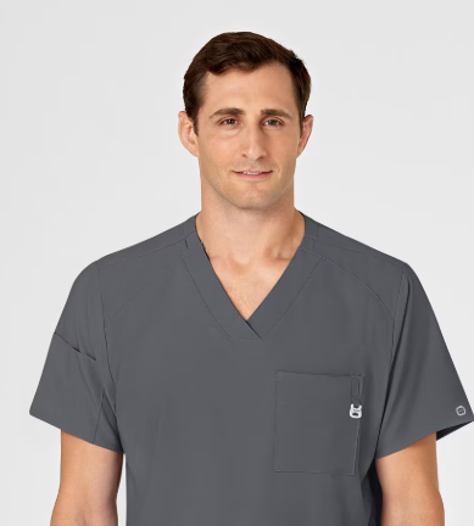
Collin Bookstore Scrub Tops (Includes Health Professions Patch):
- Color: Pewter / Brand: WonderWink
- Men's Top: Wink W123 Men’s V-neck Top, 6355 CC5. $22.98
- Women's Top: Wink W123 Women’s Stylized V-Neck Top, 6155 CC5 $22.98
Collin Bookstore Scrub Pants:
- Color: Pewter /Brand: WonderWink
- Petite/Short and Tall sizes are available.
- Women's: WonderWink W123 Women’s Flat Front Double Cargo Scrub Pant, 5155 $17.98
- Men's : WonderWink W123 Men's Flat Front Cargo Scrub Pant, 5355 $19.98
- Unisex: WonderWink W123 Unisex Multi-Cargo Pant, 5855 $18.98

Option 2
Purchase from an independent scrub retailer.
- Scrubs must be similar in style and color to the Collin College bookstore scrubs.
- Color = Pewter/Dark Charcoal, the color name will vary depending on the brand. (The scrubs MUST be Dark Gray in color, not heathered gray, black, or light gray)
- Must be professional in fit (Not too loose or too tight). Jogger-style pants are allowed. However, your lower leg area/ankle may not be exposed. Please ensure you purchase a length that is appropriate for you.
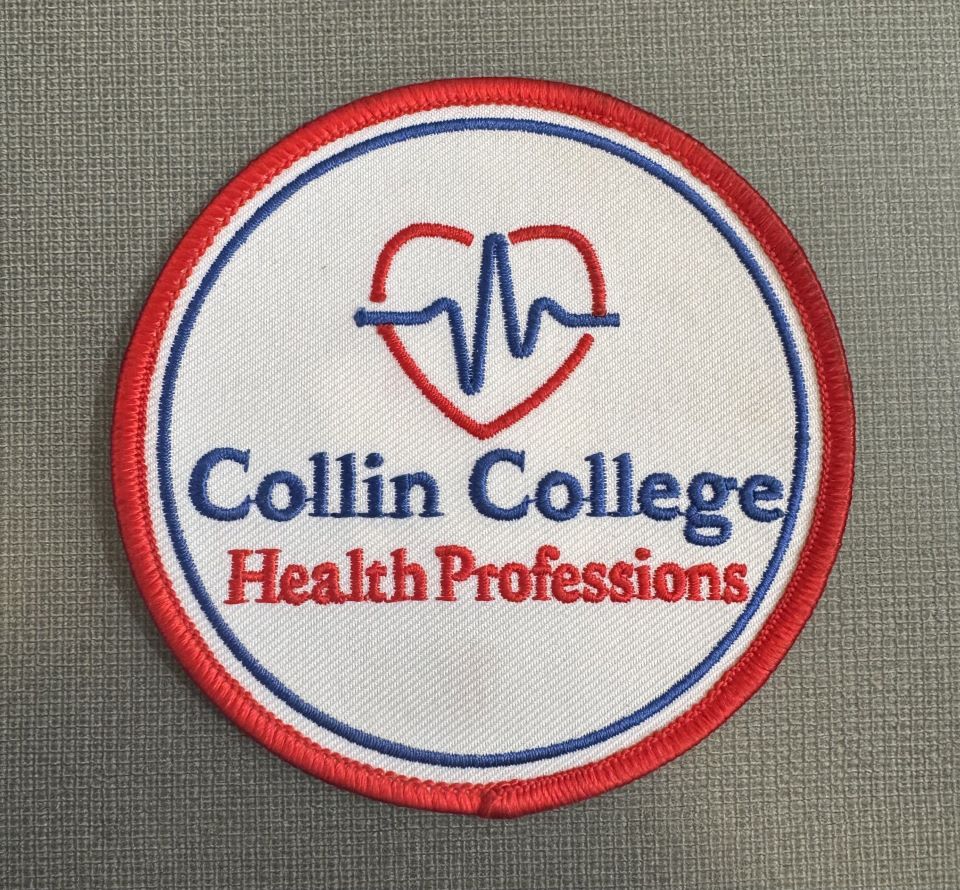
If scrubs are purchased from an independent scrub store, a Health Professions patch must be purchased and affixed to the upper left chest of the scrub top.
- Health Professions Patch: Health Profession Patch_8222, SKU: 275669379, this patch can be purchased through the online Collin College bookstore or in person at the following campuses: Technical, Wylie, and McKinney
Hoodies and/or sweatshirts are not allowed to be worn over your scrubs, you may purchase a matching scrub jacket or wear a solid (white, navy, gray, or black) undershirt if desired.
**Note: Dual Credit High School Students may be provided alternate scrubs from their home district, please check with your school before purchasing your program scrubs.
If you are having issues viewing this information in the bookstore when selecting your class location/section. Your instructor will provide this information to you on the first day of class.
No. Please do not take a drug test on your own. Our drug tests are administered on a randomly-selected date during your lecture/lab class. If you submit drug test results on your own, they will not be valid. Please be aware you are still responsible for paying for our drug test and providing a sample while tests are being administered during class. Please note: Drugs screens are not administered or required for the EKG Technician program as these students do not attend a clinical facility.
No. All students are responsible for their own reliable transportation to their assigned clinical facilities.
CNA licenses are managed by Texas Health and Human Services. For information regarding license renewals please visit the Texas HHS Nurse Aid Registry page.
The programs listed in the Licensure and Certification Disclosure Table may lead to a professional license or certification that is required for employment. Professional licensure/certification requirements vary from state to state, which may affect a student's ability to apply for a professional license or certification upon completion of a program. The U.S. Department of Education regulation, 34 CFR 668.43(a)(5)(v), requires that an institution disclose whether the program will fulfill educational requirements for licensure or certification for each state or whether the college has not made such a determination for each state.
In addition to coursework and exams, some states also have additional requirements for licensure, including other examinations and professional experience. We recommend students contact the appropriate state licensing agency in their state or the state where they intend to work to seek the most up to date information about state licensure/certification requirements before beginning any program.
Update to TX Health and Human Services Commission Nurse Aide certification requirements (April, 2026): Due to changes in Texas State agency regulations, students pursuing an occupational license will be required to provide a Social Security Number (SSN) when applying for licensure. A Taxpayer Identification Number (TIN/ITIN) will no longer be accepted as an option. This affects students pursuing an occupational license like Certified Nurse Aide (CNA).