Coming Spring 2027
The Radiologic Technology (RT) program will begin in Spring 2027 and is pursuing programmatic accreditation. The application for admission is now open.
What is Radiologic Technology?
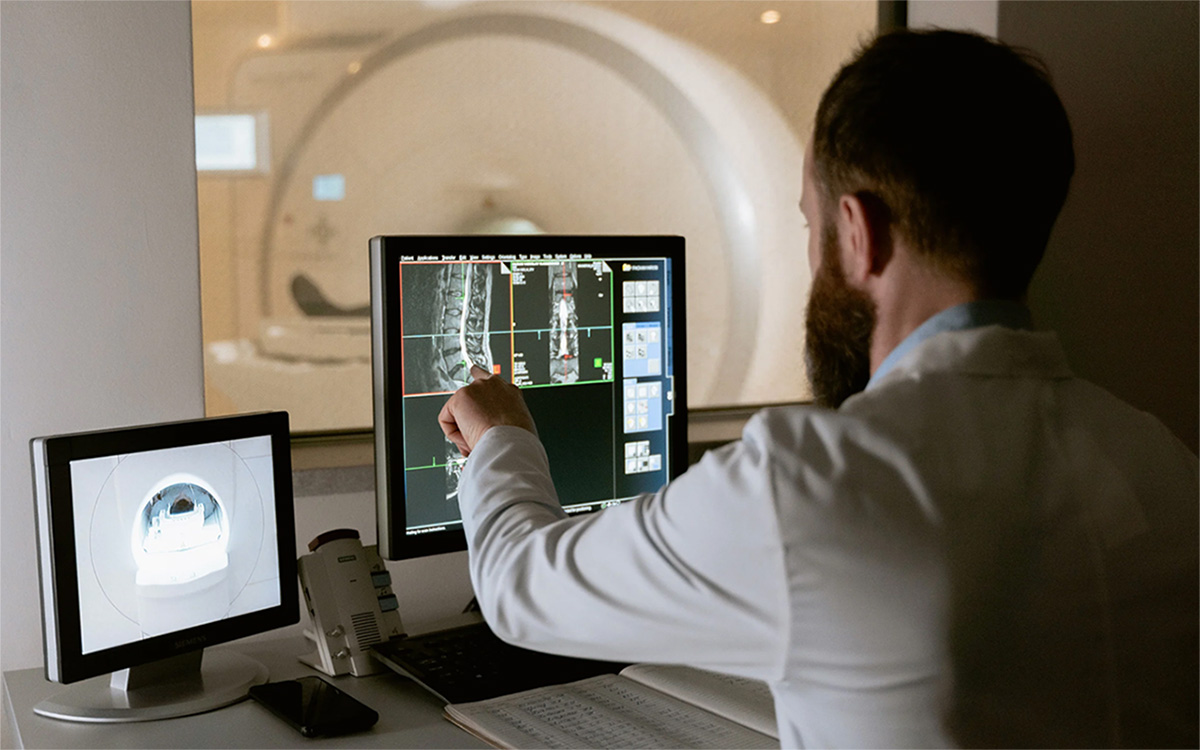
Radiologic technology is a dynamic healthcare field that uses medical imaging equipment to produce diagnostic images that help physicians diagnose and treat injuries and disease. Radiologic technologists perform a variety of imaging procedures including digital radiography, fluoroscopy, trauma imaging, mobile radiography, and surgical imaging.
Take the first step toward a rewarding career in medical imaging. Apply today!
Program Overview
The Collin College Radiologic Technology program combines classroom instruction, laboratory training, and extensive hands-on clinical experience at affiliated hospitals and imaging centers throughout North Texas. You will gain the knowledge, technical skills, and professional experience needed to produce high-quality diagnostic images while providing safe, compassionate patient care.
Graduates are eligible to sit for the American Registry of Radiologic Technologists (ARRT) certification examination and are prepared for rewarding careers in hospitals, outpatient imaging centers, physician offices, orthopedic clinics, surgery centers, and specialty healthcare facilities (pending programmatic accreditation from JRCERT, which is in progress).
Associate of Applied Science
Admission and Application Requirements
Application Process
Applicants are strongly encouraged to review program information and attend a Radiologic Technology (RT) program information session prior to applying. Attendance is voluntary and does not influence admission decisions.
The program admits one cohort each academic year.
| Activity | Timeline | ||||||||
|---|---|---|---|---|---|---|---|---|---|
| Application Opens | Sept. 1 | ||||||||
| Application Deadline | Nov. 1 | ||||||||
| Admissions Review | November | ||||||||
| Admission Decisions Begin | December | ||||||||
| Program Begins | January | ||||||||
| Note: Application dates are subject to change. | |||||||||
Step 1: Complete Prerequisite Coursework
The following prerequisite courses must be completed with a grade of "C" or better. Courses may be in progress at the time of application but must be successfully completed before program entry.
| Course | Title |
|---|---|
| BIOL 2401 | Anatomy & Physiology I |
| BIOL 2402 | Anatomy & Physiology II |
| MATH 1314 | College Algebra (or a higher-level mathematics course) |
| ENGL 1301 | Composition I |
Step 2: Complete the HESI A2 Examination
Applicants must complete the HESI Admission Assessment (A2) Exam prior to the application deadline. Testing dates are limited; applicants are encouraged to schedule and complete the examination early.
Step 3: Submit Program Application
Submit a completed RT program application and all required supporting documentation between Sept. 1 and Nov. 1 of the application year.
Download Application for AdmissionOnly the highest level of recognition in each category will be awarded. Points are not cumulative.
The Collin College Radiologic Technology (RT) program utilizes a competitive, selective admission process. Meeting the minimum admission requirements does not guarantee acceptance into the program.
Applicants are evaluated using the program’s selective admission point system and ranked based on established admission criteria. Admission offers are extended to the highest-ranked applicants based on the number of available seats in each cohort and the availability of qualified clinical education placements.
The selective admission process is designed to identify applicants who demonstrate the academic preparation, professionalism, and potential for success in the rigorous RT curriculum and clinical environment.
Applicants are selected for interviews based on their application point totals. Points are awarded in the following categories:
- Prerequisite Coursework
- HESI A2 Examination
- Prerequisite Grade Point Average (GPA)
- Bonus Points
Total Application Points Possible: 50
Note: Only the highest-scoring applicants will be selected for an interview.
Attendance at an information session or meeting with the program director is encouraged but does not contribute points toward admission. The admission criteria are subject to revision. Any changes will be published on the program website and will apply to all applicants during the applicable admission cycle.
I. Prerequisite Coursework (Maximum Points: 12)
| Course | Points | ||||||||
|---|---|---|---|---|---|---|---|---|---|
| BIOL 2401 – Anatomy and Physiology I* | 4 | ||||||||
| BIOL 2402 – Anatomy and Physiology II* | 4 | ||||||||
| MATH 1314 - College Algebra (or a higher-level mathematics course) | 2 | ||||||||
| ENGL 1301 - Composition I | 2 | ||||||||
| Total Points | 12 | ||||||||
| Note: All prerequisite courses must be completed with a grade of C or higher. | |||||||||
*BIOL 2401 and BIOL 2402 must be completed with a grade of C or better within the past five years. Coursework older than five years is generally not accepted. However, the program director may grant an exception for applicants who have documented, sustained employment in a direct patient care profession where anatomy and physiology knowledge is routinely applied. Examples include certified nursing assistant, patient care technician, medical assistant, emergency medical technologist, paramedic, licensed vocational nursing, registered nurse, respiratory therapist, surgical technologist, or other comparable healthcare roles. Waiver requests will be reviewed individually and require appropriate documentation of employment, credentials, and clinical experience.
II. HESI A2 Examination (Maximum Points: 15)
The HESI Admission Assessment (A2) Examination includes Anatomy and Physiology, Biology, Grammar, Math, Reading Comprehension, Vocabulary and General Knowledge, and Critical Thinking.
| Section | 90-100% | 75-89% | Below 75% |
|---|---|---|---|
| Anatomy and Physiology | 2 | 1 | 0 |
| Biology | 2 | 1 | 0 |
| Grammar | 2 | 1 | 0 |
| Math | 2 | 1 | 0 |
| Reading Comprehension | 2 | 1 | 0 |
| Vocabulary and General Knowledge | 2 | 1 | 0 |
| Critical Thinking | 3 | 1 | 0 |
Only the first HESI A2 attempt completed during a calendar year will be considered.
Applicants who previously completed the examination are not required to retest. If an applicant elects to retest, the most recent examination scores will be used.
III. Prerequisite Grade Point Average (Maximum Points: 10)
| GPA | Points |
|---|---|
| 3.76-4.00 | 10 |
| 3.66-3.75 | 9 |
| 3.51-3.65 | 8 |
| 3.36-3.50 | 7 |
| 3.25-3.35 | 6 |
| 3.00-3.24 | 5 |
| 2.5-2.99 | 4 |
A minimum prerequisite GPA of 2.5 is required for application eligibility. The highest grade earned within the first two attempts of each prerequisite course will be used in GPA calculations.
IV. Bonus Points (Maximum Points: 13)
Applicants may earn up to 13 bonus points toward admission to the RT program. Bonus points are awarded for academic achievement and relevant healthcare experience and are added to the applicant's overall admission score.
| Criteria | Points |
|---|---|
| Bachelor's degree or higher from a regionally accredited college or university | 2 |
| Associate degree from a regionally accredited college or university | 1 |
| Prerequisite GPA of 3.75 or higher (GPA calculated from the required prerequisite coursework) | 3 |
| One year or more of paid direct patient care experience (e.g., certified nursing assistant, patient care technician, medical assistant, EMT, paramedic, licensed vocational nurse, registered nurse, respiratory therapist, surgical technologist, or similar role) | 4 |
| Completion of a medical terminology course with a grade of C or higher | 2 |
| At least 100 hours as a hospital volunteer | 1 |
Documentation Requirements
- Official transcripts must be submitted for all coursework and degree-related bonus points.
- Healthcare employment experience must be verified through employer documentation indicating job title, dates of employment, and job responsibilities.
- The RT Admissions Committee reserves the right to review and evaluate certifications, licensure, education, and work experience submitted by applicants and to determine eligibility for bonus points based on the intent of the established criteria.
Important Information
Bonus points are awarded in addition to the standard admission requirements and do not guarantee admission to the program. Applicants may earn points in multiple bonus categories; however, the maximum number of bonus points awarded is 13. Admission is competitive and based on the overall applicant pool.
V. Interview Process
Applicants with the highest application scores will be invited to interview.
The interview is designed to assess:
- Communication skills
- Professionalism
- Knowledge of the profession
- Critical thinking abilities
- Interpersonal skills
- Commitment to the field of radiologic technology
VI. Final Selection
Applicants with the highest combined scores will receive offers of admission.
Accepted applicants should respond to the offer by the published deadline.
Applicants who accept the offer must:
- Complete all clinical compliance requirements
- Attend required orientation activities
- Complete any additional documentation required by the college or clinical affiliates
Applicants who decline admission or fail to respond by the deadline may forfeit their seat to an alternate applicant.
Admission Tiebreaker
If two or more applicants have identical point totals, the RT Admissions Committee will choose a candidate based on the following criteria:
- Higher science GPA
- Higher Anatomy & Physiology II grade
- Higher HESI/TEAS score
- Greater healthcare experience
- Earlier application completion date
Alternate Applicants
Qualified applicants who are not initially admitted may be designated as alternates.
Alternates may receive an offer of admission if an accepted applicant declines or forfeits a seat before the start of the program.
Accepted students must satisfy all clinical eligibility requirements before beginning clinical education experiences.

Additional Program Information
The Radiologic Technology program at Collin College is a new academic program offered by Collin College, an institution accredited by the Southern Association of Colleges and Schools Commission on Colleges (SACSCOC) to award the Associate of Applied Science (AAS) degree. The program is currently seeking initial programmatic accreditation from the Joint Review Committee on Education in Radiologic Technology (JRCERT).
The JRCERT accreditation process is comprehensive and includes the submission of a detailed self-study report, supporting program documentation, and an on-site evaluation to verify compliance with nationally recognized standards for radiologic technology education. The program is actively engaged in the initial accreditation review process; however, initial accreditation cannot be guaranteed prior to the graduation of the first cohort.
Graduates who successfully complete the Radiologic Technology Program are eligible to apply for the American Registry of Radiologic Technologists (ARRT) certification and registration examination, provided they meet all ARRT eligibility requirements. As a degree-granting institution accredited by SACSCOC, Collin College is authorized to award the AAS degree, which is required for ARRT examination eligibility. The program is pursuing JRCERT accreditation to further demonstrate its commitment to educational excellence and continuous quality improvement.
Accepted students must complete the following before beginning clinical rotations:
- Criminal background check
- 10-panel drug screen
- Required immunizations
- Annual tuberculosis screening
- American Heart Association Basic Life Support (BLS) certification
- Personal health insurance coverage
You are also responsible for transportation to and from all assigned clinical sites.
After acceptance and before entering clinical rotations, students will be required to provide acceptable immunization records. Due to the time needed to complete certain vaccination series, please verify records at the time of application. If not completed previously, it is recommended that the Hepatitis B series be started at the time of application. The Texas Administrative Code (TAC) and the Dallas-Fort Worth Hospital Council Foundation Community Standards require that all students in health programs complete required immunizations. Accepted students are required to provide documentation that they have completed all immunization requirements. Immunizations for students are based on the current Centers for Disease Control recommendations for health professionals.
| Vaccine | Requirement | ||||||||
|---|---|---|---|---|---|---|---|---|---|
| Mumps, Measles, Rubella | Two vaccinations or titer showing immunity is required. | ||||||||
| Varicella (chickenpox) | Vaccination or titer showing immunity is required. | ||||||||
| Tetanus/Diphtheria/Pertussis | Vaccine must be within the past 10 years. | ||||||||
| Hepatitis B | Vaccination consists of a three-dose series over a seven-month period. A titer showing immunity is also acceptable. Accelerated dosing schedules are available, but it is your responsibility to seek facilities with this option. | ||||||||
| Bacterial Meningitis | Texas State Law requires all college students under the age of 22 to be vaccinated against bacterial meningitis or provide an exemption request declining the vaccine. The vaccination must have occurred at least 10 days prior to the start of classes and must be administered within the last five years. See the Bacterial Meningitis Requirement page for further details on exemptions and how to submit documentation. | ||||||||
| Influenza* | One dose annually during flu season is required. Exceptions are made for medical and religious reasons but must adhere to hospital policies. | ||||||||
| Negative Tuberculin (TB) Test* | This is an annual requirement and can be either a negative QFT or CXR test. If you have a history of a positive PPD test or having TB, you must provide documentation of a negative CXR or completed treatment. Students with expired TB tests will not be allowed to attend clinicals and will receive unexcused absences until results are submitted. (You must be aware of the attendance policy for clinicals.) | ||||||||
| *This may be completed after acceptance. | |||||||||
The costs of these tests and immunizations are your responsibility. Select clinical sites may request additional immunization requirements.
Information on immunizations can be accessed by visiting the Centers for Disease Control and Prevention (CDC) webpage.
You are required to carry personal health insurance while in the clinical portion of the Radiologic Technology program. Proof of insurance must be made available to the program director before clinical rotations.
Be aware that eligibility for health insurance on your parent or guardian’s health insurance may require you to be a full-time enrolled student. The number of semester credit hours in which a student must be registered to be considered full time is defined by Collin College. Check with the college registrar’s office to see if you qualify as a full-time student.
All students are required to complete a criminal background check before entering the Radiologic Technology program. Be aware that acceptance to the program and placement at a practicum site does not guarantee the applicant will be allowed to become a certified radiologic technologist.
For more information, contact the Radiologic Technology program director or the American Registry of Radiologic Technologists (ARRT).
Students enrolled in the Radiologic Technology program must be able to meet the following technical standards, with or without reasonable accommodation, to successfully complete program requirements and perform the essential functions of a radiologic technologist in classroom, laboratory, and clinical settings.
| Category and Technical Standard | |||||||||
|---|---|---|---|---|---|---|---|---|---|
| Physical Requirements | |||||||||
| Stand and walk for prolonged periods during clinical procedures and patient care activities | |||||||||
| Lift, transfer, move, and position patients and/or equipment weighing up to 50 pounds | |||||||||
| Perform cardiopulmonary resuscitation (CPR) and other emergency response procedures | |||||||||
| Manipulate catheters, guidewires, imaging equipment, and other procedural instruments with precision | |||||||||
| Demonstrate fine motor skills, manual dexterity, and hand-eye coordination necessary for invasive cardiovascular procedures | |||||||||
| Reach, bend, stoop, and move safely in confined procedural environments | |||||||||
| Use lead protective equipment as needed during clinical procedures | |||||||||
| Maintain physical stamina necessary to participate in lengthy procedures that may extend several hours | |||||||||
| Sensory Requirements | |||||||||
| Observe patient conditions and recognize changes in physical, emotional, and physiological status | |||||||||
| Distinguish audible alarms, patient responses, and other critical sounds in the clinical environment | |||||||||
| Read and interpret patient monitors, imaging displays, procedural equipment screens, and hemodynamic data | |||||||||
| Differentiate colors, visual indicators, and waveform patterns used in patient monitoring and diagnostic equipment | |||||||||
| Assess patient responses through visual, auditory, and tactile observation | |||||||||
| Communication Requirements | |||||||||
| Communicate effectively, accurately, and professionally with patients, families, faculty, clinical instructors, physicians, and healthcare team members | |||||||||
| Accurately document patient information, procedural data, and clinical activities in written and electronic formats | |||||||||
| Follow verbal, written, and electronic instructions | |||||||||
| Provide and receive information effectively in routine, urgent, and emergency situations | |||||||||
| Behavioral Requirements | |||||||||
| Demonstrate emotional stability and professionalism when providing patient care and participating in invasive procedures | |||||||||
| Exercise sound judgment and maintain patient safety in all settings | |||||||||
| Maintain integrity, ethical behavior, confidentiality, and accountability for actions | |||||||||
| Function effectively and safely under stressful, fast-paced, and potentially emergent conditions | |||||||||
| Adapt to changing environments, patient conditions, and clinical situations | |||||||||
| Demonstrate professional behavior and respect for the dignity, rights, and individuality of all patients, faculty, staff, and healthcare team members | |||||||||
Note: You must meet these technical standards with or without reasonable accommodation. Requests for accommodation should be made to the college’s Accessibility Services Office in accordance with college policy and applicable federal and state laws.
Frequently Asked Questions
Employment is not prohibited; however, you should carefully consider the demands of the program.
Clinical rotations, coursework, laboratory assignments, and studying require a significant time commitment. Student success should remain the highest priority.
You may not be paid for scheduled clinical hours or complete clinical competencies at your place of employment.
Clinical education begins during the second semester of the program. Students complete approximately 1,600 hours of clinical training throughout the six-semester curriculum at affiliated hospitals and imaging centers throughout the Dallas-Fort Worth area.
You must earn a minimum grade of C in all Radiologic Technology courses. A grade below C in any Radiologic Technology course will result in dismissal from the program.
If your anatomy and physiology coursework is more than five years old, you should contact the program director for guidance regarding eligibility and possible course requirements.
Yes. Students who are currently enrolled in prerequisite or required general education courses are encouraged to apply to the program. During the application process, you should indicate that you are "currently enrolled" in any prerequisite or general education courses that have not yet been completed.
If coursework is being completed at another institution, you are responsible for ensuring that an official transcript is submitted to the program director within 15 days of the end of the semester. If coursework is completed at Collin College, the program director will have access to your final grades and transcripts.
All prerequisite requirements must be successfully completed before enrollment in the Radiologic Technology program.
Yes. Many college credits transfer to Collin College.
You should submit official transcripts as early as possible. The college will evaluate previous coursework and determine transfer credit eligibility. Because transcript evaluations can take time, early submission is strongly encouraged.
The program requires Basic Life Support (BLS) for Healthcare Providers certification through the American Heart Association (AHA).
CPR certifications from other organizations may not be accepted. You may be required to obtain AHA certification before beginning clinical education.
Applications are reviewed following the Nov. 1 deadline. The program director and clinical coordinator evaluate applicants and determine admission decisions in December. Acceptance notifications are typically sent during December. Applicants who are not selected will also receive notification regarding their admission status.
No. Because the curriculum includes laboratory instruction and clinical education, you must attend classes and clinical rotations in person.
Professional certification is the recognized standard for entry into the profession and is required by most employers. Upon successful completion of the Collin College Radiologic Technology program and satisfaction of all eligibility requirements, graduates are eligible to apply for the American Registry of Radiologic Technologists (ARRT) certification examination.
Individuals who successfully complete the ARRT certification examination may earn the Registered Technologist in Radiography, R.T.(R)(ARRT) credential, demonstrating that they have met nationally recognized standards for entry-level practice.
Texas Licensure: In addition to national certification, individuals who wish to practice radiologic technology in the state of Texas must obtain a Medical Radiologic Technologist (MRT) license issued by the Texas Medical Board (TMB). Applicants must meet all eligibility requirements established by the TMB, including successful completion of an approved educational program and passage of a recognized national certification examination.
Under Texas law, individuals must hold an active Texas MRT license before independently performing radiologic procedures using ionizing radiation equipment. Graduates are responsible for applying for and obtaining state licensure prior to beginning professional practice in Texas.
Contact Us
For program information, contact:
Wil Reddinger, MSRS, RT (R) (CT) (MR) MRSO
Radiologic Technology Program Director
Visit the Academic Advising page to learn more about degree planning and credit transfers. Visit the Admissions page and the Financial Aid page to learn how to get started at Collin College.